AC vs DC Coupling for Commercial BESS: Which Is Right for Your Project?
Table of Contents
AC coupling and DC coupling are two different ways to connect a battery energy storage system (BESS) to a solar array. The choice affects system efficiency, inverter configuration, interconnection complexity, and how the storage system operates under different load and grid conditions.
For commercial projects, choosing the wrong architecture does not mean the system will not work. It means the system will not work as well as it should, and fixing it after construction is expensive.
Here is what the difference actually means in practice.
Key takeaways
- DC coupling connects the battery on the DC side of the system, between the PV array and the inverter.
- AC coupling connects the battery on the AC side, with its own bidirectional inverter.
- The answer depends on project type more than system size.
- Regardless of coupling architecture, commercial BESS installations require engineering documentation that covers the storage system specifically.
The Basic Architecture
In any solar-plus-storage system, energy flows from the PV array to either the load, the grid, or the battery. The coupling type describes where in the electrical system the battery connects.
- DC coupling — The battery connects on the DC side of the system, between the PV array and the inverter. A single hybrid inverter manages both the PV generation and the battery charging and discharging.
- AC coupling — The battery connects on the AC side of the system. The PV array has its own inverter. The battery has its own bidirectional inverter. The two systems are electrically independent.
DC Coupling: How It Works
In a DC-coupled system, DC electricity from the PV array flows directly to the battery via a charge controller, or to the hybrid inverter which handles both charging and inversion in one unit.
When the array is generating more power than the load requires, the surplus goes to the battery. When the battery is full and generation exceeds load, excess power goes to the grid. The inverter manages all of this in a single device.
Efficiency advantage: In DC coupling, PV energy that goes to the battery never gets converted to AC before storage. It stays DC, gets stored as DC, and gets converted to AC once when it is discharged to the load or grid. Round-trip efficiency for DC-coupled systems is typically 92 to 96%.
Fewer conversion steps means less energy loss.
Configuration constraint: The PV array and battery are both sized to the hybrid inverter's capacity. If you want to expand either in the future, you may need to replace the inverter. DC coupling is less modular than AC coupling.
Best fit: New construction, greenfield projects, systems designed from scratch with solar and storage as an integrated package. DC coupling is the right choice when you can design the solar and storage together and you want maximum round-trip efficiency.
AC Coupling: How It Works
In an AC-coupled system, the PV inverter and the battery inverter are separate units connected on the AC bus. The PV inverter converts DC from the array to AC as it would in a solar-only system. The battery inverter converts between AC and DC for charging and discharging.
When the array generates surplus power, the AC flows through the battery inverter to charge the battery. Discharging works in reverse. The two inverters operate independently and communicate through an energy management system that coordinates dispatch.
Flexibility advantage: The PV system and the battery system are independent. You can add storage to an existing solar installation without changing the PV inverter. You can expand the battery independently of the PV system. The architecture is modular.
Efficiency trade-off: Energy going to the battery is converted from DC to AC by the PV inverter, then from AC back to DC for storage. When discharged, it converts from DC to AC again by the battery inverter. That extra conversion step reduces round-trip efficiency to roughly 88 to 92%, versus 92 to 96% for DC coupling.
Best fit: Retrofits. Adding storage to an existing solar installation. Projects where the PV system was designed first and storage is being added later. Projects where separate system control of PV and storage is preferred for grid services.
Which One to Choose
The answer depends on project type more than system size.
| Topic | DC coupling | AC coupling |
|---|---|---|
| Where the battery connects | DC side, between the PV array and the inverter | AC side, with its own bidirectional inverter |
| Round-trip efficiency | Typically 92 to 96% | Roughly 88 to 92% |
| Modularity | Less modular | Modular: PV and battery are independent |
| Best fit | New construction and greenfield projects | Retrofits |
Choose DC coupling when:
- The solar and storage are being designed together as a new installation
- Maximizing round-trip efficiency is a priority (on-site consumption or behind-the-meter economics)
- The system is sized and you do not expect significant future expansion
- The application is peak shaving, demand charge reduction, or backup power where every kWh of stored energy counts
Choose AC coupling when:
- You are adding storage to an existing PV system with a standard string or central inverter
- You want to independently expand the solar and storage over time
- The storage system will participate in grid services (frequency response, ancillary services) where the battery inverter needs independent control
- You are in a market with a complex interconnection agreement that treats the PV system and battery system as separate resources
The Retrofit Case
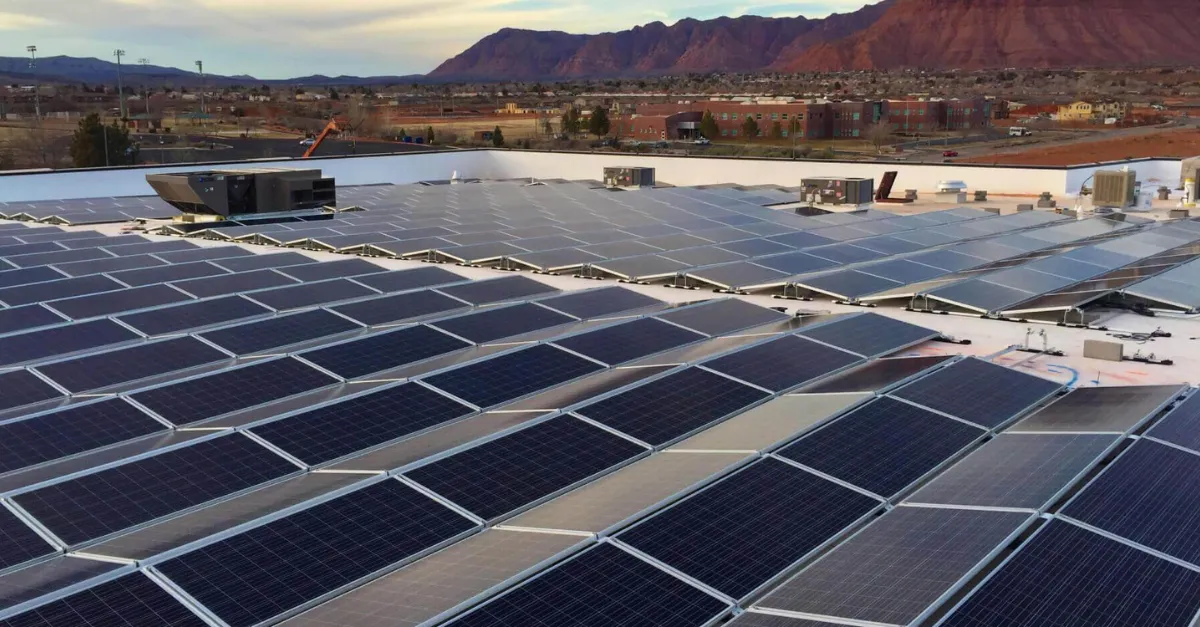
The clearest application for AC coupling is the retrofit. A commercial building with an existing 200 kW PV system and a standard central inverter cannot cost-effectively be DC-coupled for storage. Replacing the PV inverter with a hybrid inverter sized to the existing array is often as expensive as the storage system itself.
Tip: AC coupling keeps the existing PV inverter in place and adds a battery inverter independently.
For new construction, DC coupling is almost always the right technical choice if the inverter manufacturer's hybrid product supports the required system size and grid interconnection requirements.
Engineering Considerations for Commercial BESS
Regardless of coupling architecture, commercial BESS installations require engineering documentation that covers the storage system specifically.
- NEC Article 706 — Energy storage systems are covered under NEC Article 706, which establishes installation requirements for battery systems including disconnecting means, overcurrent protection, and thermal management.
- NFPA 855 — The Standard for the Installation of Stationary Energy Storage Systems covers fire safety requirements: separation distances, ventilation, firefighter access, and suppression system requirements for battery chemistries. Many AHJs are now enforcing NFPA 855 requirements for lithium-ion BESS, and some utilities are requiring NFPA 855 compliance documentation as part of the interconnection review.
- Interconnection documentation — The BESS needs its own single-line diagram showing how it connects to the AC bus, the PV system, the load panel, and the utility interconnection point. The interconnection agreement needs to specify how the battery can and cannot operate in relation to the grid (anti-islanding, grid-forming vs. grid-following, export limits).
- Dispatch and controls documentation — For commercial systems where the battery will participate in demand response or grid services, the energy management system's dispatch logic needs to be documented and the inverter controls need to align with the utility's stated requirements.
Sources: NFPA 70, National Electrical Code (Article 706) and NFPA 855.
Design your BESS system with a licensed engineer who understands both sides of the system: joltengineering.com/bess-design-services
Questions about what solar engineering covers are answered on our commercial solar engineering page: joltengineering.com/commercial-solar-engineering
Frequently Asked Questions
When is AC coupling the better choice?
AC coupling fits retrofits: adding storage to an existing PV system with a standard string or central inverter. It also suits projects that want to expand solar and storage independently over time, and storage that will participate in grid services where the battery inverter needs independent control.
When is DC coupling the better choice?
DC coupling fits new construction where solar and storage are designed together as one installation and maximizing round-trip efficiency is a priority. It suits applications such as peak shaving, demand charge reduction, or backup power, where every kWh of stored energy counts.
Which codes apply to commercial BESS?
Commercial BESS installations require engineering documentation that covers the storage system specifically. NEC Article 706 covers energy storage systems, including disconnecting means, overcurrent protection, and thermal management. NFPA 855 covers fire safety requirements such as separation distances, ventilation, firefighter access, and suppression systems.

Founder & Principal of Jolt Engineering. 17+ years in commercial solar. Spent a decade on the EPC and client side before founding Jolt in 2017 to solve the problems he experienced firsthand.